
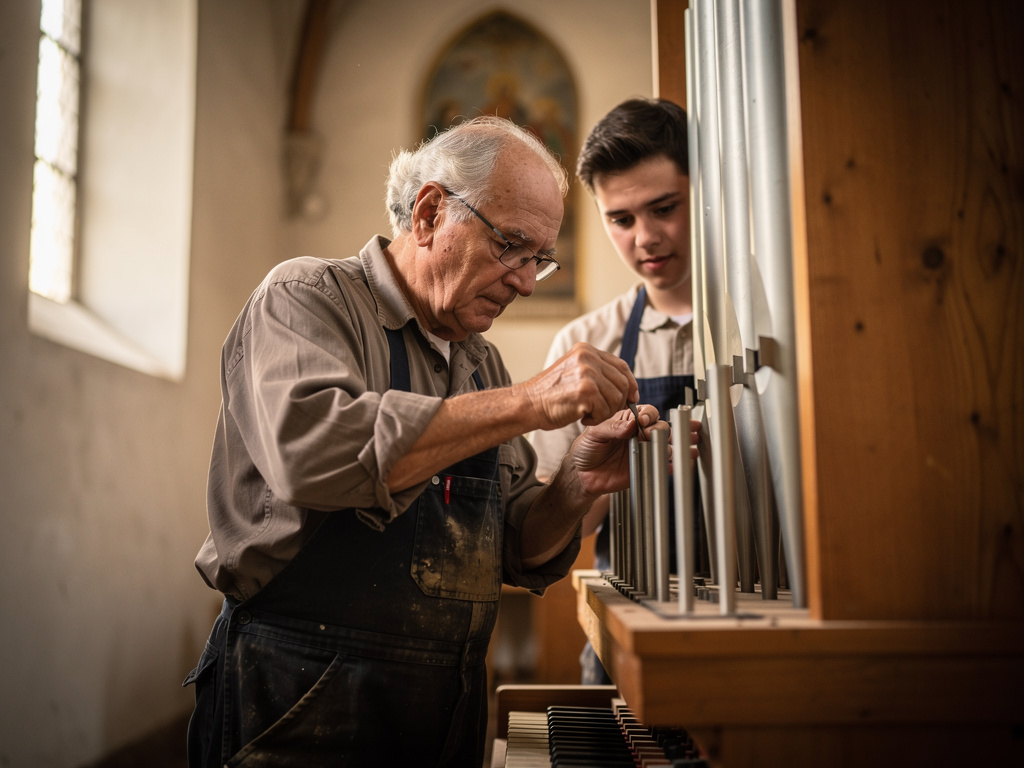
The key points in brief
- Building a church organ yourself is a fascinating but extremely demanding project – from the choice of materials through the planning to safety.
- Building a pipe organ yourself requires craftsmanship, a great deal of time and considerable expense.
- For parishes that need genuine organ music quickly and cheaply, a digital organ app is the practicable alternative.
- eKlecia® delivers over 1,000 hymns recorded on real pipe organs – without building, maintenance or tuning.
This article is not intended as a DIY tutorial, but rather to explore the possibility of building a church organ for musical performance yourself. The following overview is a basic list of steps for building an organ from scratch, including important considerations and resources.
Introduction: What is a church organ and why should you build one?
An organ is a keyboard instrument with a soundboard and pipes. The sound of an organ can imitate a wide variety of instruments, which makes it a versatile instrument. The first church organs appeared in the first century.
The first church organs appeared in the first century as accompaniment to other instruments. In the 17th century, both German and Italian Baroque composers wrote many pieces for it as an instrument in its own right. In English cathedrals, the organ was often installed at the west end of the cathedral, because choirs sang from there.
Church organs are a fixed part of parishes. Organ builders, however, are hard to come by and building one often takes years. With the help of 3D printing, organs can be built faster and for less money than ever before. Today's designs use modern materials that are lighter, more durable, and easier to maintain and reproduce.
How to choose the right materials for your church organ
Pipe organs are often the most expensive element of a church organ. Although they are not suited to every kind of music, they are great-sounding instruments that can be heard throughout the sanctuary.
Wooden pipe organs are not only cheaper to build than their larger counterparts, but also easier to maintain and transport. These three tips will help you choose the right material for your organ.
1) Save money on the foot pedals by buying a high-quality keyboard pedal instead. 2) When choosing wood for the pipes, use hardwoods such as pine or poplar instead of softwoods such as spruce or fir. 3) Consider using solid wood for the front panels instead of plywood or MDF boards. Solid wood panels are the best option for durability. Solid wood panels are stronger, stiffer and less prone to bending or warping over time. They are also easier to attach to the frame, as the grain usually runs perpendicular to that of the frame.
How to plan your DIY church-organ design from start to finish
The process of designing a church organ is a fascinating one, since it involves very different disciplines and skills. Does your church need a new organ but you have no experience in organ design?
No problem! In these 5 steps you can learn how to plan a DIY church-organ design from start to finish!
1) Find a reference photo
This is the most important step. A good reference photo tells you everything you need to know to build your own church organ. First, look for a photo that is in colour and gives a clear view of the entire organ. It is advisable to find a photo that also includes the keys, pedals, pipes and the console, so that you have everything you need.
Pipe organs are a staple in most parishes. The high cost of a traditional pipe organ, however, can keep many churches from having one. Nowadays there are companies that sell DIY organs which can be assembled for a fraction of the cost.
2) What needs does your church have? What needs does the congregation have? You may need an organ to accompany your choir or to provide background music during the Sunday service.
3) Design and build the frame
The frame is the basis of all your other work and sets the tone for your organ. Think about what look and feel you want for your organ and let yourself be inspired by other organs. For the frame, we opted for a simple wooden frame with a finished look.
– Buy an inexpensive wood such as pine or poplar, enough to build the desired frame size.
– Cut the wood to the right size, leaving a little extra wood on each side
4) Start by adding an amplifier
An amplifier is the device that converts audio signals into something you can hear. It is important to have one for your church-organ design.
“An amplifier is the device that converts audio signals into something you can hear.”
The best way to find the right amplifier for your church-organ design is through research on the internet. There are many different sources of information that can help you get to know the various features and advantages of different amplifiers.
Once you have done some research, it is a good idea to narrow things down.
5) Share your design
To finish your project, share the story of your DIY church organ on social media and let others know how they can do it too. Connect with friends and followers to start a discussion about the design and the process of designing a DIY church organ.
eKlecia® – The digital solution for your parish
With the eKlecia® app you accompany every service with professional organ music – regardless of whether an organist is available. Over 3,000 hymns, flexible control and easy operation for every parish.
Try it free now – no download, no technical knowledge required. View all pricing plans →
Safety tips when working on your DIY church-organ project
Organ building has many dangerous aspects. Here are some safety tips you should keep in mind:
– Avoid the use of electricity. You have to handle many very sharp objects that can easily cause an electric shock.
– Make sure you always wear gloves – the oils from your skin can impair the quality of your work and possibly damage parts that are already installed.
– Make sure you have a first-aid kit as well as an experienced doctor or someone familiar with medical emergencies nearby, in case something goes wrong during your project.
Conclusion & resources for building a pipe organ yourself
-Learn more about pipe organs
-Find a place to build the organ
-Find materials
-Build the frame
-Build the pipes
-Create the keyboard
-Create the pedalboard
-Connect the pipes and keyboard
For everyone who wants it simpler: eKlecia®
Our app is an organ for your phone – you can play wonderful melodies and hymns with it. The eKlecia® app is a digital organ with which you can play music on your smartphone. If you have no access to an organ in church, this could be a good alternative. eKlecia offers a service that lets you access and share music that would otherwise be unavailable. This is especially beneficial for people who, for various reasons, cannot go to church or the cathedral and therefore can neither see nor hear these instruments.
When you use eKlecia® on your smartphone, you have instant access to a wide range of musical pieces. The settings for pitch, stops and speed can all be adjusted with the app.
To download the app, go to the Apple Store and search for “organ” or “eKlecia®”. For more information about our products, visit https://eklecia.org/
eKlecia has developed a music app for churches that offers intuitive features and is intended to breathe new life into them.
Would you like to find out how eKlecia® can support your parish?
→ eKlecia® for parishes
→ All features of the eKlecia® app
→ Discover over 3,000 hymns
→ Prices and free trial access
→ Get in touch now
Frequently asked questions
Can you build a church organ yourself?
In principle yes, but building a pipe organ yourself is extremely demanding and requires craftsmanship, a great deal of time and considerable expense.
What do you need to build a pipe organ?
Suitable materials such as wood and metal for the pipes, well-thought-out design planning, and attention to important safety considerations.
Is there a simpler alternative to a self-built organ?
Yes. A digital organ app such as eKlecia® delivers over 1,000 hymns recorded on real pipe organs – entirely without building, maintenance or tuning.
More articles

Gotteslob or Evangelisches Gesangbuch? The Two Great Hymnals at a Glance
The organist shortage in 2026: causes, extent and how churches find solutions today