The Problem of the Organist Shortage: Structural Causes, Historical Roots and Ways Out of the Crisis
The key points at a glance
- The shortage of organists is not a new phenomenon, but the consequence of decades of structural failures.
- In the Protestant Church alone, around 60 positions have to be filled each year – a structural shortfall of about 25 positions per year.
- Four causes act together: the demographic wave of retirements, gaps in fostering new talent, unattractive remuneration and structural change within the Church.
- The remedies are training support, fair remuneration, regional cooperation, greater appreciation – and digital tools as a bridge.
The shortage of organists is not a phenomenon of recent years — it is the fruit of structural failures that have been maturing for decades. Anyone who wants to understand why dozens of parishes today are left without organists must know the history of the profession, the training systems and the economic conditions. A stocktaking — and a realistic look ahead.
In Germany there are today over 50,000 pipe organs — a density unmatched anywhere in the world. Yet more and more of these instruments are falling silent. Not because they are broken, but because there is no longer anyone to play them. In some dioceses of Bavaria, in Protestant church districts of Mecklenburg-Western Pomerania, in Middle Franconian parishes as in Westphalian village churches — everywhere church leaders report the same phenomenon: positions are advertised, no one applies. Stand-ins are sought, no one comes. A volunteer organist retires, and with that the organ music in the parish ends.
This article analyses the structural causes of the organist shortage in Germany, shows the consequences for services, funerals and pastoral care and discusses which paths dioceses, regional churches and parishes can realistically take today — including the role that digital tools play in this.
How the organist profession came about and developed
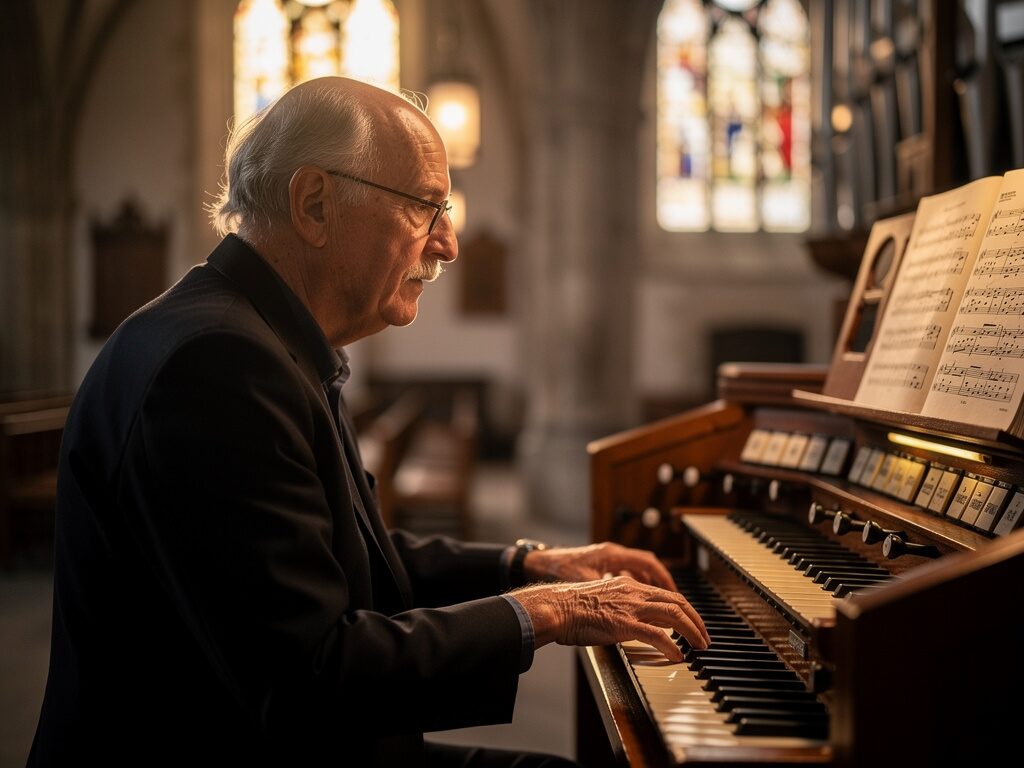
The profession of church organist is old — and its present-day crisis has deep historical roots. For centuries the organist was a central figure in parish life: often at once cantor, teacher, choir director and musical point of contact for weddings, funerals and feast days. Composers such as Johann Sebastian Bach, Dietrich Buxtehude and Max Reger were organists — and shaped sacred musical life far beyond their own lifetimes.
Until the second half of the 20th century the professional profile was stable: every larger parish had a full-time or at least substantial part-time position, often tied to a civil-service post in church-run schools. Esteem was high, remuneration decent, the supply of new talent secure. Anyone who played the piano and had a religious grounding found in church music an attractive, socially recognised path.
That world no longer exists in this form. With the separation of school and church, with the changing role of the teacher, with the creeping erosion of voluntary structures — and above all with the waves of secularisation from the 1970s onwards — the organist's position became a marginal one. What remained was a patchwork of full-time church musicians in the larger towns and an army of volunteer players spread across the countryside. And it is precisely this army that is now ageing and disappearing.
The creeping crisis — structural causes
The crisis has not one but several interlocking causes. Anyone who wants to understand the shortage of organists must grasp them as a bundle — and, consequently, the solution too.
1. Demographics: the wave of retirements
The generation of full-time church musicians active today was born in the 1950s and early 1960s — and is now retiring. In the Protestant Church in Germany alone, around 60 positions fall vacant each year, while only about 35 graduates of church-music degree courses enter service. A structural shortfall of 25 positions per year — and that only in the Protestant sphere, without the Catholic side and its roughly 9,500 parishes in Germany.
Among the volunteer organists — who in many rural parishes bear the real burden — the situation looks even more serious. Most of these players are today between 60 and 80 years old. A new generation on a comparable scale is nowhere in sight.
2. The education system: where the fostering of new talent fails
Anyone who wishes to study church music today does not have it easy. Places at music academies are limited, the entrance examinations demanding, and the professional outlook after graduation often discouraging: part-time C and D positions with modest pay, frequently in merged parish associations involving long distances.
On top of this comes a more fundamental problem: most children no longer encounter the organ in everyday life. Anyone growing up in a secular home knows the instrument only from films or by hearsay. The low-threshold points of contact — the Sunday service, the May devotion, the children's choir rehearsal — are missing. Without this grounding, no interest in the next generation arises.
The church training system distinguishes four levels:
- A examination — fully professional full-time church musicians, with a completed degree from a music academy.
- B examination — full-time service at regional level, likewise with a higher-education degree.
- C examination — part-time service, recognised in all EKD regional churches, often alongside another job.
- D course — a low-threshold entry point, also for career changers and volunteer players.
Even the low-threshold offerings — D courses and C training — are too little used. This has less to do with a lack of musical talent than with a lack of visibility, a lack of appreciation and a lack of pay.
3. Economics: the question of pay
In many parishes, part-time organists are paid fees that barely cover their effort. €50 to €80 per service is not uncommon — for two to three hours of rehearsal, one's own travel costs and the mental responsibility of carrying the liturgy without a break. Anyone juggling a main job, family and private life on the side eventually asks whether this is sustainable in the long run.
Full-time positions, in turn, are rare and, when they fall vacant, are often bundled together within merged parish associations — which means: a full-time organist no longer looks after one parish but three or five, with rotating duty, weekend stress and double bookings. This makes the position unattractive to young talent who, at that stage of life, are seeking stability and clarity.
4. Structural change in the Church
The churches themselves are in upheaval. At the end of 2025, only 43.8% of the German population were still members of one of the two major churches. More than 600,000 people left the two churches in 2025 alone. Fewer members mean less church tax — and therefore a smaller budget for church musicians, leaner staffing structures, and more difficult job advertisements.
Parishes merge, positions are combined, voluntary structures erode. This is not only a financial but also a cultural phenomenon: where once there was a lively parish with active church music, today there is often only a parish association with a monthly celebration of the Eucharist — and no post that feels responsible for cultivating the musical tradition.
Consequences for services, funerals and pastoral care
The effects of the organist shortage are impossible to overlook in practice — and they reach far beyond Sunday Mass.
“Last year our parish association had 47 funerals. At 18 of them we had no organist. That means: 18 families had to say goodbye without organ music. That is a pastoral question, not a technical one.” — A priest from the Diocese of Würzburg
Sunday services increasingly take place without organ accompaniment. A silent congregation, because the hymns cannot be intoned, leaves a different impression than a liturgy with music. In some parishes CD recordings or cantors are used — stopgaps that do not do justice to every congregation.
Funerals are particularly affected. In the event of bereavement, the mourning family are usually in no state to arrange a stand-in organist at short notice. If the parish cannot offer a solution, either the burial has to be postponed or the service is musically thin. Dealing with funerals without an organist has by now become a pastoral topic in its own right.
Care homes and hospitals are hit twice over. Here it was traditionally volunteer organists who came once a month free of charge or for a small expense allowance — a practice that is crumbling with the change of generations. The consequences are set out in detail in the article “Care homes without an organist”.
Weddings, baptisms and first communions are less often affected, but here too the situation is worsening. Anyone who wants a church wedding and wishes for organ music must today often take the initiative themselves — and sometimes pays external organists three-figure fees plus travel.
What dioceses, regional churches and parishes can do
Solutions to the crisis are rarely simple — but they do exist. Anyone in a position of responsibility in a diocese, a church district or an individual parish who wishes to act should consider a bundle of measures:
Actively support training
D and C courses should be offered, promoted and funded across the board in every diocese. Parishes that identify music-loving members should cover the course costs in full — a small investment set against the long-term cost of an empty organ bench. Part-time weekend courses, online modules and mentored learning paths can also help people get started at a low threshold.
Establish fair remuneration
Fee schedules should be communicated transparently and adjusted to economic reality. Whoever pays €80 for three hours of work not only recruits no one — they also alienate the few who are still there. Clear fee regulations, uniform across a region, with adjustments for travel and difficulty, are a long-overdue step.
Build regional cooperation
In some regions, models work in which several parishes share a full-time organist — with clear fee agreements, coordinated service times and short distances. Here the dioceses and regional churches can act as coordinators and actively promote such models.
Make appreciation visible
Church musicians — full-time and voluntary alike — feel that in many parishes they are perceived as a service to be taken for granted, whose importance only becomes visible when it is missing. A deliberate culture of appreciation — at parish festivals, in sermons, in the parish newsletter, at the annual reception — costs nothing and has an enormous effect. Anyone who feels needed and seen stays longer.
The role of digital tools — bridge or threat?
One question divides the discussion: are digital organ-music applications the rescue — or do they hasten the end of the profession? The honest answer is: neither. They are a tool whose effect depends on the wisdom with which it is used.
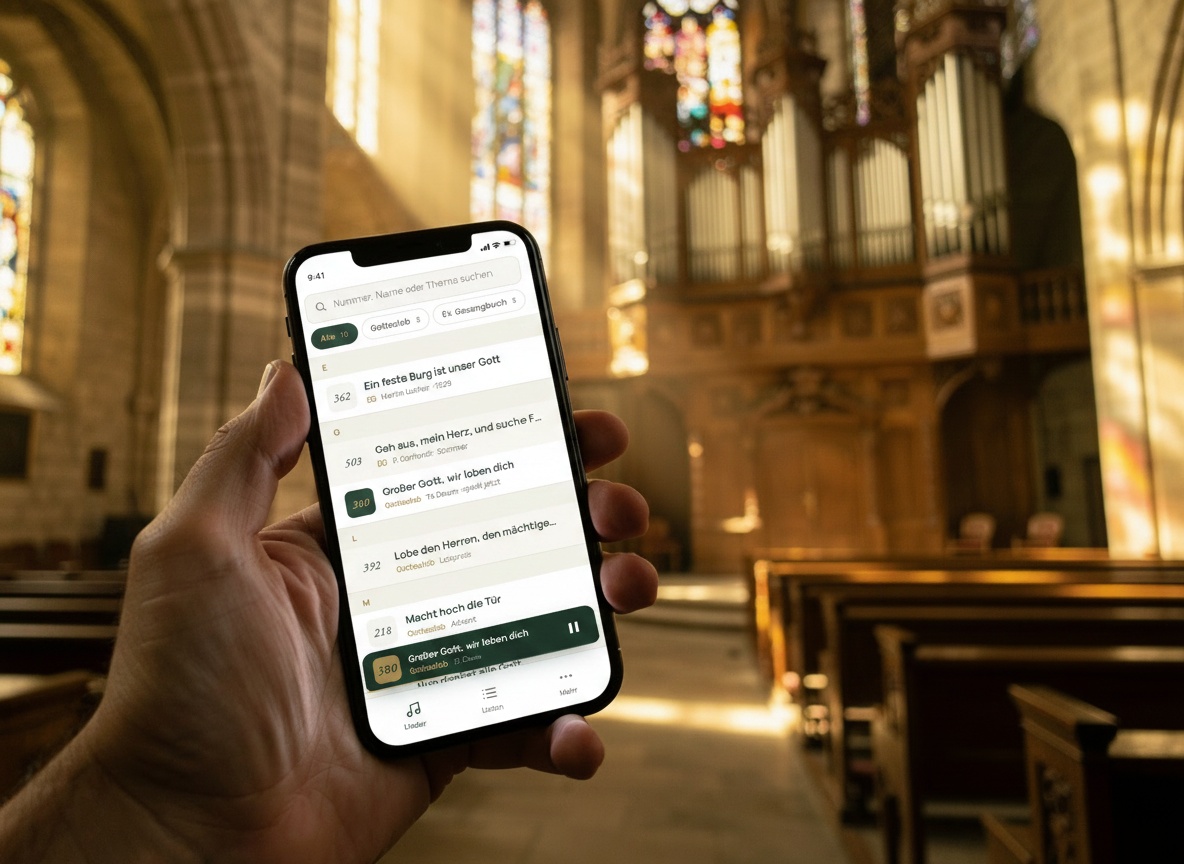
Digital solutions such as the eKlecia® app are no competition for living church musicians. They close the gap that the living organist can no longer fill: the blessing at the care home on a Sunday morning, the funeral two days after an unexpected death, the small devotion in the hospital chapel without a pastoral post. In regions where there is simply no living organist left, the alternative is not “app vs. living organist”, but “app vs. silence”.
At the same time — and this is often overlooked in the discussion — digital tools relieve the burden on the full-timers who remain: they no longer have to turn out for every weekday blessing, accompany every birthday in the care home, play every small devotion themselves. They can concentrate on the musically demanding high points — and leave the routine to the digital tools. This makes the profession more attractive again, not less.
What matters is this: digital solutions do not replace the structural task of fostering new talent and making positions attractive. They are a bridge — not a solution to the underlying question.
A realistic outlook
The shortage of organists in Germany will worsen further over the next ten years, before — with a wise structural response — it can stabilise. The next five to seven years will be marked by a wave of retirements that is not offset by new talent. Parishes, dioceses and regional churches that do not act now will find themselves, in five years' time, with silenced organs.
Those who act today can achieve a great deal:
- Foster new talent: actively promote training in the D and C courses, support it financially, and make it visible in parishes and congregations.
- Keep existing organists: fair remuneration, genuine appreciation, clear working conditions — what people need in every profession.
- Bridge the transition: use digital tools where living organists are not available — at blessings, funerals, home devotions. Not as a replacement, but as a bridge.
- Modernise structures: regional cooperation, joint fee regulations, cross-parish stand-in schedules.
German church music has a rich, centuries-old tradition. It will remain alive in the coming decades too — but it will look different than before. More cooperation, less going it alone. More pragmatism, less glorification of the “good old days”. More courage to build bridges — and, at the same time, more investment in the tradition we want to preserve.
Anyone who thinks and acts along today — as a priest, as a parish council member, as a diocesan official, as a church musician themselves — ensures that church music in Germany does not become a memory, but remains a living language of the community.
Further articles and solutions for your parish:
→ The shortage of organists in 2026: figures, data, the current situation
→ Funeral without an organist — dignified music in difficult moments
→ Care homes without an organist
→ eKlecia® — all the app's features
→ Prices and trial access
→ Request a personal consultation
Frequently asked questions
Why are there so few organists?
Four reasons: the demographic wave of retirements, too little fostering of new talent, unattractive remuneration and structural change with parish mergers.
How many organist positions are affected?
In the Protestant Church alone, around 60 positions have to be filled each year, with a structural shortfall of about 25 positions per year.
What are the consequences of the organist shortage?
Services, funerals and pastoral care are increasingly left without musical accompaniment.
What helps against the organist shortage in the long term?
Active training support, fair and transparent remuneration, regional cooperation and visible appreciation – complemented by digital organ solutions as a reliable bridge.
Are digital tools a threat to church music?
No. They are a bridge: they step in where no organist is available, but they do not replace the fostering of living organ playing.