Care Homes Without an Organist: How Senior-Care Facilities Secure Musical Accompaniment Today

The key points in brief
- Familiar hymns often still reach people with dementia even when speech has already been lost.
- The shortage of organists hits care homes particularly hard – an organist is scarcely to be found for monthly in-house services.
- Four options secure the musical accompaniment: an external fee-based organist, volunteer musicians, CD/streaming, or a digital organ app with genuine pipe-organ sound.
- An app such as eKlecia® is available around the clock, considerably cheaper than regular fee-based musicians, and can be operated without any musical background.
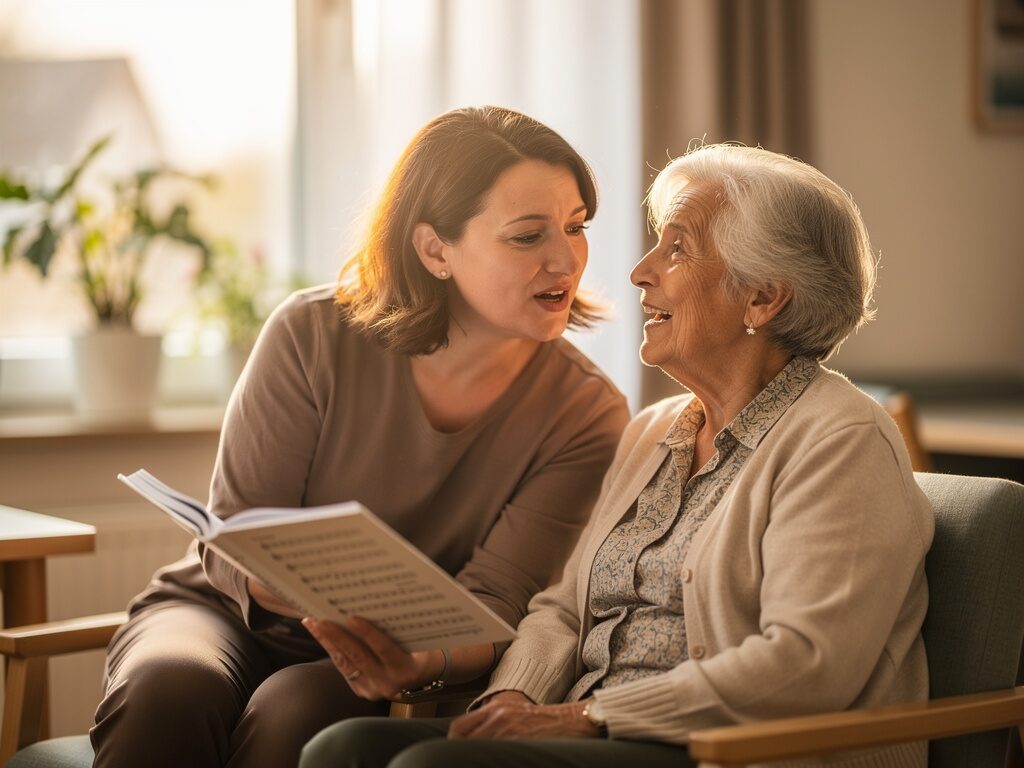
When the priest comes to the care home once a month for the in-house service, the celebration should be dignified. The residents have known their hymns since childhood — and they still sing along even when speech has already been lost to dementia. But who provides the musical accompaniment for the service once the volunteer organist has retired?
The shortage of church musicians hits care homes particularly hard — harder than many parishes themselves. For unlike a town church, where the Sunday Mass has grown over decades, services in a care home are usually small, intimate celebrations: twenty residents in the day room, the priest in his vestments, a simple cross, a candle — and, ideally, music that has accompanied these people since their First Communion or their wedding.
This article shows what home managers, social services and care staff can do when their own organist is missing: which solutions have proven themselves in practice? What does dementia research really show about the effect of familiar music? And what does a dignified service look like when no live organ is available?
Why music is indispensable in the care home
Music works in the care home in a way that is scarcely as observable in any other phase of life. Residents who have barely spoken for weeks suddenly begin to sing along as soon as the first bars of „Großer Gott, wir loben dich" ring out. Men who have grown restless with dementia become calm the moment „Wer nur den lieben Gott lässt walten" is heard. These observations are not anecdotes — they are borne out by a growing body of studies and by daily experience in German senior-care facilities.
In people with advanced dementia in particular, music reaches areas of the brain that other cognitive stimuli no longer address. Procedural and emotional memory — precisely those areas in which hymns have been stored since childhood — often remain remarkably intact for a long time. A resident who no longer recognises her own husband can sing „Befiehl du deine Wege" along, verse by verse. For relatives this is often a moving moment — and for care staff a clear sign of how precious these moments are.
What research really says about music and dementia
The figures from the Deutsche Alzheimer Gesellschaft speak a clear language: around 1.8 million people in Germany live with dementia today, roughly half a million of them in care facilities. By 2050 the number is expected to rise to as many as 2.8 million. Dementia is thus no longer a special case in care, but the daily reality of a considerable proportion of residents. This makes the question of daily structure, stimulation and dignity — and of music — a core question of modern care.
What research has shown over the past two decades: music with biographical meaning — precisely those songs a person has heard often in their life — can ease depressive moods, reduce restlessness and measurably increase well-being. In people who grew up in a Catholic or Protestant milieu, church music almost always belongs to this biographical collection. The weekly Sunday Mass, the wedding, the funerals, the pilgrimages — they all have a fixed canon of hymns anchored deep in emotional memory. It is this biographical depth that makes church music especially effective in the care home.
The organist shortage hits care homes especially hard
For a long time, volunteer organists — mostly retired teachers, homemakers, local musicians — accompanied the in-house services in senior-care facilities. They came once a month, without a fee, often only for a small token at Christmas. This generation is now retiring itself — and there are no successors. The structural shortage of organists in Germany thus hits care homes twice over: they have neither a budget for professional church musicians nor realistic prospects of finding volunteers.
“Our residents look forward every month to the service with Frau Hofmeister. But Frau Hofmeister is now 82 and rightly says she can no longer do it. What are we supposed to tell the residents? That from now on there is only a service with a cassette recorder?” — Head of Social Services, care home in Lower Bavaria
On top of this: senior-care facilities are often in rural areas, far from town churches with a full-time cantor's post. Even when a priest comes to the home once a month for a service — he brings no organist with him. The problem is therefore not primarily a question of money, but a question of structural availability. And this is precisely where practicable solutions come in.
Which hymns are especially effective in the care home
Over the years, a core repertoire has crystallised for the musical accompaniment of in-house services and deathbed blessings (Aussegnungen). These hymns work — they are understood, they are sung along to, they have an effect. Care managers and chaplains in German care homes report, largely in agreement, the following classics:
- Großer Gott, wir loben dich — perhaps the best-known German hymn of praise, a safe anchor even in mixed groups of residents.
- Lobe den Herren, den mächtigen König der Ehren — solemn, memorable, often the first hymn of a service.
- Wer nur den lieben Gott lässt walten — heartfelt, measured, especially effective with dementia patients.
- Maria, breit den Mantel aus — indispensable in Catholic regions, above all in Bavaria and southern Germany.
- So nimm denn meine Hände — at commendations and services for the dying, often the only hymn that residents still perceive at the end of life.
- Befiehl du deine Wege — Paul Gerhardt's hymn of trust, which returns even after decades away from church.
- Segne, du Maria — in many Bavarian and Austrian homes a fixed part of the May devotion (Maiandacht).
- Von guten Mächten wunderbar geborgen — Bonhoeffer's text, by now well known in the older generation too.
The selection should follow the region of origin and the denominational background of the residents. In a Protestant home in northern Germany, chorales by Paul Gerhardt and Martin Luther are standard; in a Catholic home in Bavaria, Marian hymns must not be missing. A well-stocked hymn database — analogue or digital — should be able to cover both repertoires.
Four ways care homes secure musical accompaniment today
1. External organist on a fee basis
The classic solution: a substitute organist from a neighbouring parish who comes once a month for the service. Advantage: living, adaptable music. Disadvantage: hard to find, fee plus travel (usually €100–250 per appointment), no availability for spontaneous commendations or home visits to dying residents. For many homes a first, but shaky, mainstay.
2. Volunteer musicians with another instrument
Some homes are lucky: a staff member plays the accordion, a relative the guitar, a resident even the harmonium. Such solutions are often touching and create a family feeling. But they rarely replace the organ in its solemn effect — and they fail the moment the person playing is unavailable.
3. CD and streaming solutions
Pragmatic and inexpensive, but with weaknesses: who actually has the right funeral and devotional hymns to hand as a high-quality organ CD? Streaming services often offer only piano versions or recordings with a full choir, which sound out of place in a small day room. Then there is the operation — choosing a hymn, repeating a verse, adjusting the volume — which quickly becomes a challenge when the Wi-Fi goes on strike.
4. Digital organ app with genuine pipe-organ sound
For a few years now, digital solutions developed specifically for use in parishes and care facilities have become established. The features of the eKlecia® app, for instance, offer over 1,000 hymns, recorded on real organs in German churches — by experienced cantors, in various keys and tempos. A carer, a home manager or a pastoral assistant selects the hymn, presses start, and can concentrate on the service. The sound is pipe-organ quality — no MIDI synthesis, no generic sounds.
eKlecia® in the care home — reliable accompaniment around the clock
Over 1,000 hymns, intuitively operated from any tablet or smartphone. Developed specifically for care facilities — including services for the dying at the resident's bedside.
Request trial access — Try it now with no obligation →
Digital accompaniment in practice — experiences from German homes
How does digital organ music actually change everyday life in a senior-care facility? Reports from homes that have worked with an app solution for two or three years are remarkably consistent.
“At first we had doubts about whether our residents would notice the difference. After three months I can say: they don't. They sing along, they beam, they look forward to the next service. What they perceive is: there is music again. They need nothing more.” — Head of Nursing Services, senior-care facility in Lower Saxony
A carer in the Bavarian Allgäu puts it like this: “I used to simply cancel the in-house service when Frau S. couldn't come. Today I switch on the app, and our residents have their Sunday service — even when the priest can't come in person. That has taken an enormous weight off us as a home.”
Cost-effectiveness and practical implementation
The honest assessment: a digital solution in the care home today typically costs between €1,500 and €2,500 per year — comparable to about ten services with a substitute organist. Unlike the fee-based organist, however, the app is available 365 days a year: for bedside commendations, for spontaneous May devotions, for a little lunchtime music in the dining hall, for that Sunday morning when no one comes.
The pricing structure is usually set up as a monthly subscription — cancellable, without commitment, with a trial period. Important for practical implementation: invest once in a decent Bluetooth speaker, ideally with a wired connection as a backup. The sound quality in a day room with a hard floor and bare walls cannot be compensated for by a better app — only by suitable speakers.
More than the in-house service — structuring the day with music
An often underestimated aspect: a good hymn database covers not only services but also what care professionals call „daily structuring". A short midday service with two hymns. A Marian hymn by the window in May. A „Stille Nacht" on Christmas Eve when the relatives come. Funeral music at a small commendation in the resident's room. These are all moments that would be almost impossible to arrange with classic solutions — call an organist, find a date — but are possible in minutes with an app.
Hospitals and hospices too are increasingly discovering this function: when a patient dies and their family asks for a short commendation, a trained carer with a tablet and speaker can create a dignified accompaniment in minutes. This is the quiet, often overlooked strength of digital solutions: they democratise church music for those moments in which, classically, there was nothing — neither organist nor programme.
A realistic outlook
Care homes today are not faced with the question of whether to switch to digital solutions — they are faced with the question of whether they can continue to offer their residents dignified music. The choice is rarely „live organist versus app". The choice is „app versus no music at all". In this reality, professional digital accompaniment is not a last resort, but a serious alternative.
What home managers, social services and chaplains should examine today:
- Stocktaking: How many in-house services, commendations and musical moments were there in the past year — and how many of them had to take place without music?
- Speaker infrastructure: Does the home have mobile Bluetooth speakers with decent sound quality? If not, that is the first investment.
- Training: Which staff members can operate a digital solution? Ideally several people per shift.
- Repertoire: Which hymns suit the residents? A good hymn database should be flexible by denomination and region.
- Trial phase: Before a long-term decision, test it in practice for at least four weeks — ideally including a commendation or a major feast day.
Anyone who, as a home manager or head of social care in a senior-care facility, takes these steps seriously secures not only music — but dignity. And that is what residents need most urgently at the end of their lives.
Would you like to find out how eKlecia® can support your senior-care facility?
→ eKlecia® for care homes and senior-care facilities
→ All features of the eKlecia® app
→ Listen to over 1,000 hymns
→ Prices and trial access
→ Related article: Funeral service without an organist
→ Get personal advice now
Frequently asked questions
Why is music so important in the care home?
Familiar hymns awaken memories and emotions and are often sung along to by people with dementia, even when speech has already been lost.
How can care homes secure musical accompaniment without an organist?
Through four routes: an external fee-based organist, volunteer musicians, CD/streaming solutions, or a digital organ app with genuine pipe-organ sound.
Which hymns are especially suitable in the care home?
Well-known, traditional hymns from the Gotteslob and the Evangelisches Gesangbuch that residents have known since childhood.
Is a digital organ solution economical for care homes?
Yes. It is considerably cheaper than a regular fee-based organist, available around the clock, and can be operated even by care staff with no musical background.